How many tables do you need for a wedding?
A quick way to work out your table count, plus the extra tables couples usually forget.
4 min read · By the Everest team · Updated November 2026
Divide your guest count by the number of seats per table and round up. With round tables of 10, 100 guests need 10 tables and 200 guests need 20, plus a head or sweetheart table. With tables of 8, you need about 25% more tables. Then add space for the cake, gifts, DJ and any buffet.
- Tables of 10: guests ÷ 10, rounded up.
- Tables of 8: guests ÷ 8, rounded up.
- Add a head table plus service tables for cake, gifts and the DJ.
What is the formula for wedding tables?
Take your expected guest count, not your invited count, subtract anyone seated at the head table, and divide by the seats per table. Round up, because a half-empty table is better than a guest without a seat.
Example: 180 guests, with 10 at the head table, leaves 170 guests. At 10 per table that is 17 guest tables, plus the head table, for 18 tables in total.
How many tables for 50, 100, 150, 200 or 300 guests?
| Guests | Tables of 10 | Tables of 8 |
|---|---|---|
| 50 | 5 | 7 |
| 80 | 8 | 10 |
| 100 | 10 | 13 |
| 150 | 15 | 19 |
| 200 | 20 | 25 |
| 250 | 25 | 32 |
| 300 | 30 | 38 |
| 375 | 38 | 47 |
These counts are guest tables only. Add your head table or sweetheart table, and check whether your venue counts children and vendors in the same total.
Should you use tables of 8 or 10?
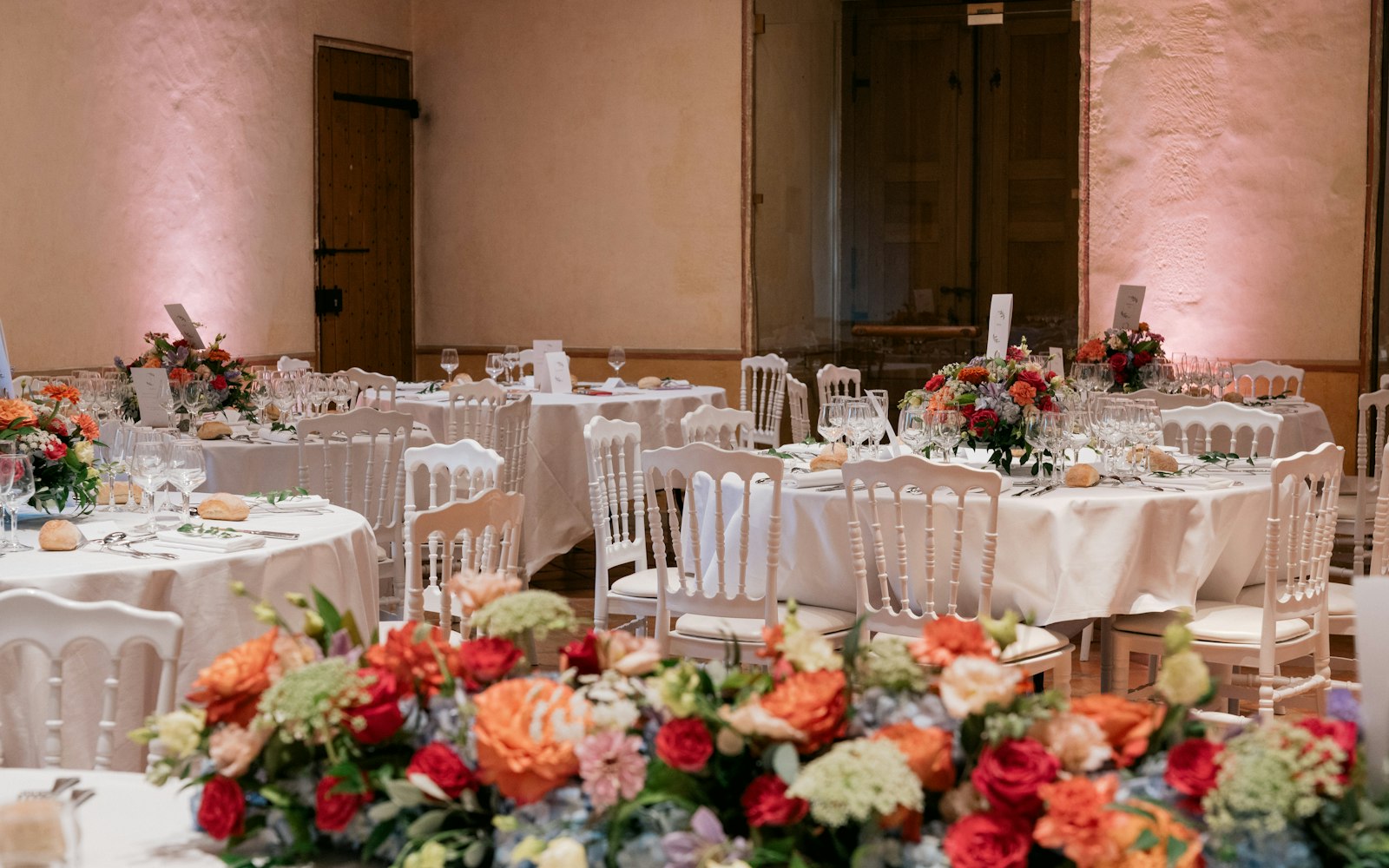
Round tables seating 10 are the standard for larger weddings because they fit more guests in the room and reduce the number of centrepieces you need. Tables of 8 feel roomier and make conversation easier, and they work well for smaller weddings or when plates, glassware and centrepieces take up a lot of space.
At Everest, our hall seats up to 375 guests at round tables of ten, and we set the room just as carefully for 60. Our floor plan and planner page shows how different layouts fit.
What extra tables do couples forget?
- Head or sweetheart table: see our guide to head tables vs sweetheart tables.
- Cake table: placed where guests can see the cutting.
- Gift and card table: near the entrance, ideally somewhere supervised.
- Guest book and seating chart: at the entrance, with room for a queue.
- DJ or band: usually beside or on the stage, with power nearby.
- Buffet or food stations: if you are not serving a plated meal.
- Vendor meals: photographers and DJs need somewhere to eat, often a small table near the back.
- Kids’ table: optional, close to parents.
How should you lay out the tables?
Put the head table where everyone can see it, with the dance floor in front. Seat close family nearest to the head table and the dance floor, and older guests away from the speakers. Leave clear paths to the bar, washrooms and exits. Once the table count is set, use our wedding seating chart guide to fill the tables.
Quick answers
How many tables do I need for 100 guests?
Ten round tables of 10, or 13 tables of 8, plus a head or sweetheart table.
How many tables for 200 wedding guests?
Twenty tables of 10 or 25 tables of 8, plus the head table.
How many people fit at a 60-inch round table?
Usually 8 to 10 guests. A 72-inch round seats 10 to 12.
Do I count the head table in my table total?
Count it separately. Subtract head-table guests from your total before dividing.
Should vendors have their own table?
Yes, a small table near the back lets photographers and DJs eat quickly without taking guest seats.
Want help with the layout?
We will map your guest count onto our hall, from the head table to the dance floor.